Answer Engine Optimization (AEO) is the architectural practice of structuring, formatting, and verifying web content to maximize direct passage extraction and source citation by generative AI answer engines. While traditional SEO focuses on ranking whole URLs in organic listings, AEO engineers discrete 2D DOM bounding boxes for minimal token inferencing cost and unambiguous factual attribution.
What Is Answer Engine Optimization (AEO)? The 2026 Architectural Guide
Search is undergoing a fundamental structural transition. For over two decades, search engines functioned as index librarians, matching keyword strings to full-page documents and returning ranked lists of blue hyperlinks. Today, answer engines—powered by multimodal Large Language Models (LLMs) and Retrieval-Augmented Generation (RAG) pipelines—operate as synthetic research analysts. They do not merely point users toward possible destinations; they read, parse, compress, synthesize, and generate definitive answers directly in the search interface.
This evolution demands a corresponding paradigm shift in digital publishing: Answer Engine Optimization (AEO).
AEO is not an algorithmic trick or a speculative set of prompts. It is an empirical engineering discipline grounded in information retrieval physics, layout-aware multimodal parsing, and Knowledge Graph entity reconciliation. To succeed in modern generative answer engines like Google AI Overviews, Perplexity, and ChatGPT Search, technical teams must understand how autonomous retrieval pipelines inspect web documents—not as flat text strings, but as multi-dimensional coordinate grids combining letters, pixels, and bytes.
What Are Answer Engines and How Do They Work?
An answer engine is an information retrieval system that decomposes user prompts, searches indexed corpora for relevant factual passages, synthesizes a cohesive natural language answer, and attributes supporting evidence through retroactive source citations.
Unlike legacy search engines that score documents at the macroscopic whole-page level, answer engines operate through a continuous 4-stage lifecycle that evaluates microscopic content blocks.

Stage 1: Query Decomposition & Prompt Fan-Out
When a user submits a prompt, modern answer engines rarely execute a single keyword search. Instead, an orchestration LLM decomposes the prompt into semantic intents, resolving entity constraints, temporal boundaries, and underlying sub-questions. For example, a complex query like "What is AEO and how do I measure it?" is fanned out into parallel retrieval threads:
- Core entity definition:
Answer Engine Optimization definition mechanics - Comparative taxonomy:
AEO vs traditional SEO differences - Measurement framework:
AI search citation tracking methodology
Stage 2: 2D Multimodal Block Retrieval
Using the fan-out sub-queries, the system queries its primary index to retrieve a candidate set of high-authority documents (typically encompassing URLs ranking anywhere from positions 1 through 30). Rather than ingesting the full HTML document, modern retrieval engines segment pages into 2D spatial bounding boxes.
According to Google Search Central's official AI features guidance, candidate documents must satisfy foundational organic search standards: clean HTTP status codes, mobile responsiveness, fast Core Web Vitals, and verified topical authority. However, candidate retrieval merely qualifies a page for consideration—passage extraction is decided at the layout layer.
Stage 3: Multi-Source Synthesis & Compression
The synthesis engine gathers extracted blocks from multiple candidate domains into the model's active context window. Here, the LLM performs semantic compression:
- Cross-references factual claims across retrieved passages.
- Eliminates redundant introductory prose and boilerplate marketing jargon.
- Synthesizes a unified response that directly satisfies the user's intent.
Stage 4: Retroactive Citation & Source Attribution
Once the response text is generated, the answer engine executes an attribution pass. The model scans its synthesized sentences against the original candidate bounding boxes, assigning inline citations and clickable source badges to the pages whose extracted passages provided the highest factual confidence.
Crucially, brand mentions and source citations are distinct algorithmic outcomes:
- A brand mention occurs when an answer engine names your organization in its synthesized text as an entity of authority.
- A source citation occurs when an answer engine provides a direct, clickable hyperlink to your specific URL in its citation carousel or footnotes.
Securing both requires satisfying the physics of multimodal document understanding.
The Multimodal Extraction Physics: Patent US12393768B2
A foundational misconception in legacy SEO is that AI answer engines read web pages as continuous 1D streams of raw text or markdown. Under this outdated assumption, content creators believed that stuffing keywords into paragraphs or adding an arbitrary FAQ block at the bottom of an article was sufficient for AI discovery.
Google's granted patent US12393768B2 (Layout-Aware Multimodal Document Understanding) definitively disproves the flat-text model.
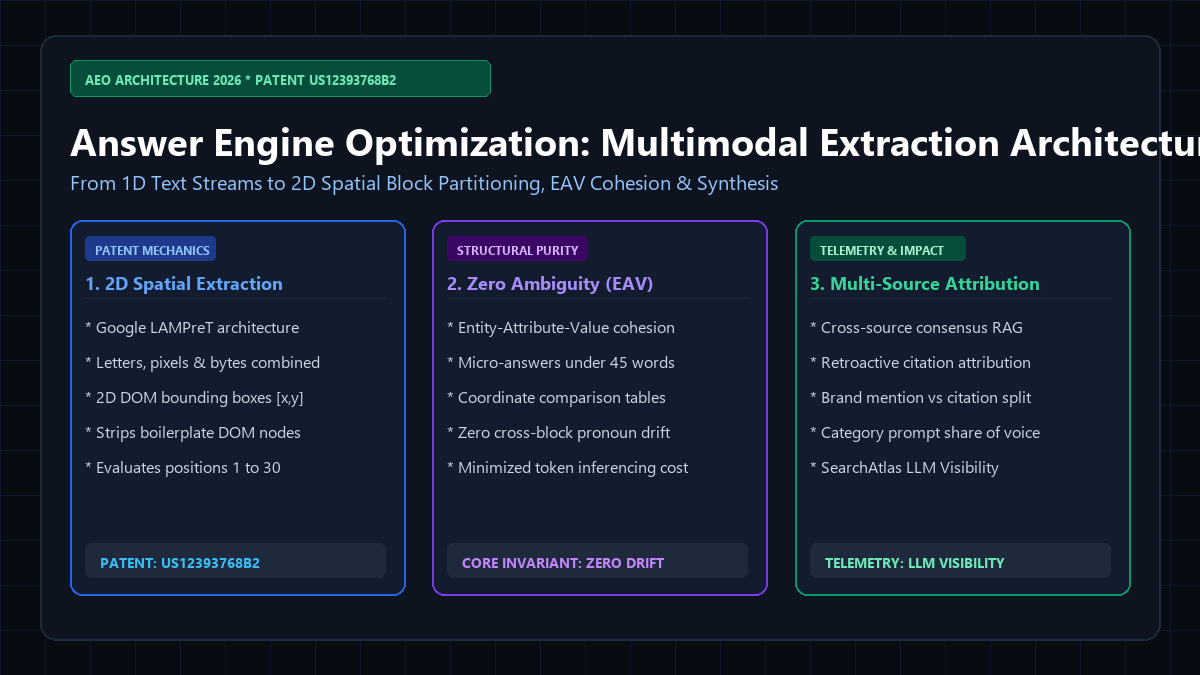
Answer engines evaluate web pages using multimodal vision-language architectures (such as Google's LAMPreT framework). Under US12393768B2, web documents are ingested and analyzed from three simultaneous data dimensions:
- Letters (Text Embeddings): Tokenized semantic vocabulary, lexical meaning, and factual entities.
- Pixels (Visual Styles): Rendered typography, font weights, background contrast, padding, and visual hierarchy.
- Bytes (Spatial Coordinates): Rendered 2D bounding boxes
[x0, y0, x1, y1], absolute DOM positioning, and spatial layout geometry.
Multimodal Extraction Vector:
Block_Score = f(Text_Semantic_Fit, Visual_Salience_Weight, Spatial_Coordinate_Proximity)
When an answer engine processes a rendered web page, it maps every heading, paragraph, list, and table into spatial coordinate blocks. If a factual statement is visually separated from its governing heading, or if a critical definition is buried below three screens of personal storytelling, the model assigns the block a low extraction confidence score due to high inferencing cost.
The 3 Core Extraction Invariants
To achieve consistent citation eligibility under patent US12393768B2, content architectures must enforce three structural invariants:
1. Zero Inferencing Ambiguity (EAV Cohesion)
Answer engines must never be forced to guess which entity an attribute belongs to. Every factual claim must maintain strict Entity-Attribute-Value (EAV) cohesion within a single bounding box.
- Failure Mode: Writing "It offers high speed and low latency" three paragraphs after naming your software. The multimodal extractor suffers from pronoun drift and discards the passage.
- AEO Invariant: Explicitly bind the entity to its attribute within the same coordinate block: "SearchAtlas LLM Visibility tracks multi-engine AI share of voice with daily prompt refreshes."
2. Explicit Entity-Attribute Tables
Multimodal extractors are heavily optimized to parse 2D structured grids. When data is formatted in an HTML coordinate table, the spatial relationship between column headers (attributes) and row keys (entities) eliminates inferencing ambiguity, dramatically lowering the token cost required for the LLM to verify factual consensus.
3. Above-the-Fold Answer Density
The physical pixel distance between a question heading and its definitive answer directly influences passage extraction confidence. Answer engines heavily favor documents that deliver immediate micro-answers (under 45 words) in the first DOM element immediately following an H2 or H3 heading.
How AEO Differs from SEO and GEO
As search evolves, technical teams must delineate precise operational boundaries between adjacent optimization disciplines:
| Architectural Dimension | Traditional SEO | Answer Engine Optimization (AEO) | Generative Engine Optimization (GEO) |
|---|---|---|---|
| Target Surface | 10 Organic Blue Links & SERP Snippets | Synthesized AI Answer Boxes & Carousels | Full Generative Chatbots & LLM Pre-Training |
| Retrieval Unit | Entire URL / Web Document | Discrete 2D Spatial DOM Bounding Boxes | Token Vector Clusters & Knowledge Embeddings |
| Optimization Currency | Crawl Equity & PageRank Hyperlinks | Layout Hierarchy, EAV Cohesion & Answer Density | Entity Salience, Brand Co-Occurrence & Digital PR |
| Primary Metric | Organic Rankings, Impressions & Clicks | Inline Source Citations & Prompt Share of Voice | Generative Brand Sentiment & Mention Share |
| Extraction Failure Mode | Thin Content, Low PageRank, Technical 404 | Inferencing Ambiguity, Pronoun Drift & Buried Answers | Semantic Invisibility across Pre-Training Corpuses |
| Measurement Environment | Google Search Console & Web Analytics | SearchAtlas LLM Visibility & Prompt Audit Logs | LLM Prompt Benchmarks & Academic RAG Suites |
For a deep comparative analysis of traditional vs. answer-led ranking factors, see our dedicated guide on AEO versus traditional SEO. If your organization is auditing acronym boundaries across executive teams, consult AEO, AIO, and GEO taxonomy, or explore our foundational framework for Generative Engine Optimization (GEO).
How to Architect Content for Answer Engine Extraction
Architecting content for AEO requires engineering every page as a modular, inspectable knowledge node. Follow these 5 production pillars:
1. Answer-First DOM Hierarchy & Heading Proximity
Every question-led heading (H2 or H3) must be immediately resolved in its very first sentence.
- Avoid introductory fluff ("In today's fast-paced digital environment, many marketers wonder...").
- Provide an immediate, self-contained micro-answer (under 45 words) that remains factually complete even if extracted in total isolation from the rest of the page.
- Expand on nuance, caveats, and implementation workflows only after the primary definition is established.
2. Entity-Attribute-Value (EAV) Structural Cohesion
Ensure that every subject, specification, and comparative metric is explicitly attributed to its proper entity:
- Define technical acronyms on first mention, followed by a consistent short form.
- Use explicit subject nouns rather than ambiguous demonstrative pronouns (this, that, it, they).
- Align entity naming conventions with verified Knowledge Graph nodes (Wikidata, schema
sameAsdefinitions).
3. Coordinate Tables Over Narrative Prose
Whenever comparing products, methodologies, architectural specifications, or pricing tiers, use HTML tables rather than bulleted narrative paragraphs. Tables provide unambiguous 2D spatial coordinate boundaries that multimodal extractors parse with maximum confidence and minimal token reconstruction cost.
4. Primary Research Citations & Verifiable Data
Answer engines are trained to prioritize verifiable primary evidence over subjective opinion.
- SearchAtlas empirical research across 18,377 matched query pairs ("How GPT Results Differ from Search Engine Results") revealed that median domain overlap between traditional search results and generative responses is under 15% for GPT and Gemini, and 25% to 30% for Perplexity.
- Support all claims with primary research, peer-reviewed standards (NIST, ISO), or direct experimental data.
- Excise unverified third-party forecasts and speculative timelines that trigger AI hallucination filters.
5. Technical Accessibility & Clean DOM
A page cannot be extracted if it cannot be cleanly parsed:
- Ensure the document renders fully without requiring client-side hydration delays or JavaScript execution bottlenecks.
- Maintain strict HTML5 semantic hierarchy (
main,article,header,table,ol). - Understand schema limitations: While schema markup provides structured metadata for traditional rich snippets, SearchAtlas's study “The Limits of Schema Markup for AI Search” demonstrated that higher schema coverage does not causally increase LLM citation probability. Schema supports eligibility; content layout governs extraction. For implementation details, see structured data for AEO.
For specialized autonomous agent architectures and tool-calling protocols, explore our guide to agentic AEO execution.
Measuring AEO Performance (Without Search Console Confusion)
A major hurdle for SEO leaders is attempting to track AEO performance through legacy tools. Google Search Console does not provide isolated AEO telemetry. Google aggregates impressions and clicks from AI Overviews into the standard "Web" search type, commingling traditional organic link clicks with generative answer interactions.
Furthermore, traditional analytics platforms cannot detect when your brand is synthesized in an answer without receiving a click. If an answer engine provides a complete response that satisfies the user, zero website visits are logged—yet your brand may have achieved massive commercial influence.
Effective AEO measurement requires a structured, repeatable prompt monitoring framework that isolates 5 distinct signals:
The 5 Core AEO Measurement Signals:
1. Mention Share: Frequency of brand entity inclusion in synthesized answers.
2. Citation Share: Frequency of clickable domain URL attribution in citations.
3. Sentiment & Framing: Whether the brand is positioned as a market leader or trailing alternative.
4. Prompt Coverage: Percentage of category-defining prompts triggering brand presence.
5. Referral Actions: Downstream conversions attributed to generative referral parameters.
To establish empirical visibility tracking across Google AI Overviews, Perplexity, and ChatGPT, leverage dedicated multi-engine tracking via the SearchAtlas LLM Visibility platform, or execute an initial diagnostic baseline with our AI visibility checker.
Commercial Tool Evaluation
Evaluating software platforms designed to monitor, analyze, and optimize generative engine citations requires objective testing across prompt sampling, model variance, and multi-engine tracking coverage.
AEO tools are a buyer category within AI visibility software. To compare them on prompt coverage, engine coverage, citations, competitor visibility, alerts, exports, and pricing, see how to evaluate AI visibility and AEO tools.
Pre-Flight AEO Verification Checklist
Before publishing search-targeted content, verify your document against the 8-point AEO readiness rubric:
- Answer-First Invariant: Primary head query resolved definitively in paragraph 1 (under 400 characters).
- Micro-Answer Proximity: Every H2/H3 followed immediately by an under-45-word micro-answer.
- 2D Spatial Layout: Document includes coordinate comparison tables and structured visual data.
- EAV Cohesion: Zero ambiguous pronouns separating entities from their attributes.
- Multimodal Asset Grounding: Verified editorial PNG (1200x675) and vector SVG schematics embedded.
- Primary Research Grounding: All claims supported by inspectable data or official documentation.
- Clean DOM Semantics: Content accessible without client-side JavaScript hydration delays.
- Zero-Orphan Lateral Linking: Bidirectional link bridges established to relevant cluster hubs.
Frequently Asked Questions About AEO

What is Answer Engine Optimization (AEO)?
Answer Engine Optimization (AEO) is the engineering practice of structuring, validating, and formatting web content so generative answer engines (such as Google AI Overviews, Perplexity, and ChatGPT Search) can extract, synthesize, and cite discrete content passages with zero inferencing ambiguity.
Does schema markup guarantee an AEO citation?
No. Schema markup defines structured metadata but does not guarantee inclusion in AI answer responses. Empirical research from SearchAtlas across 18,377 queries demonstrates that answer engines prioritize visual layout density, heading-to-answer proximity, and verifiable factual triples over JSON-LD coverage.
Does AEO replace traditional SEO?
No. AEO complements traditional SEO. Traditional SEO secures indexing, crawl efficiency, and candidate retrieval (positions 1 through 30), while AEO optimizes layout-aware passage extraction and retroactive citation attribution within the generated answer block.
What is the single biggest cause of answer extraction failure?
The primary cause of extraction failure is inferencing ambiguity: burying factual answers beneath conversational fluff, separating entities from their attributes across multiple DOM blocks, and relying on ambiguous pronouns instead of explicit Entity-Attribute-Value (EAV) structures.